Showing posts with label new. Show all posts

Tuesday, May 30, 2017

Boston & Maine Hampton NH Structures 1974

These are Hampton, New Hampshire area photos dated July 1974.  They were acquired a while ago in a large lot.  The photographer is unknown.


Hampton NH
Hampton NH (rear)
Hampton NH Today
North Hampton NH
North Hampton NH Today

Tuesday, April 4, 2017

MRC/Model Power Boston & Maine / New Haven 2-6-0 Locomotives in N Scale

2-6-0 MOGUL BOSTON & MAINE DCC COMPATIBLE - 0687601
2-6-0 MOGUL BOSTON & MAINE DCC & SOUND - 06876011

2-6-0 MOGUL NEW HAVEN DCC COMPATIBLE - 0687617
2-6-0 MOGUL NEW HAVEN DCC & SOUND -  06876171

ANNOUNCED APRIL 2017:  Boston & Maine 4-4-0 American steam locomotive. One road number per scheme.  Five-pole Mashima motor with flywheel; metal boiler, chassis, and cylinders; separately applied metal handrails; factory-installed traction tire; and golden-white light-emitting diode headlight. Direct-current model, $269.98; with Digital Command Control and sound, $339.98. Model Rectifier Corp., 732-225-2100


Saturday, March 7, 2015

New MBTA Chief Frank DePaola Takes Charge of Agency

(SOURCE:  Boston Globe)

This is the mess that Frank DePaola walked into on his first day as the new head of the Massachusetts Bay Transportation Authority:

The T recently revealed it would need to spend about $6.7 billion to repair and upgrade its trains, rails, and stations to be in good working order.
The commuter rail system, walloped by the winter, is still operating on a reduced schedule after weeks of late or canceled trains.
And an angry public is demanding refunds for a disastrous month of interrupted service.
But if DePaola was overwhelmed by the what ails the T on Wednesday, his first day as interim general manager, he didn’t let on.

MBTA sets upgrade costs at $6.7b

The board that oversees the T also expressed skepticism about issuing refunds for poor service, saying repair and upgrades take priority.

Instead, he struck a matter-of-fact note when he said in an interview: “I mean, of course, it’s a challenge.”

DePaola, who took over the T after Beverly A. Scott last month abruptly announced plans to step down, has served as the state transportation department’s highway administrator. He says that experience will help him lead the T next time it is socked by a big snowstorm.
DePaola started on the day Governor Charlie Baker also released his budget for the next fiscal year, which includes $1.172 billion for the T’s operating budget.

On Wednesday, a small group of public transportation advocates held a rally on Beacon Hill to demand even more state funding for the T.

“We need to make sure our Legislature does not forget that transportation has to be at the top of our priority list even when the snow melts,” said Kristina Egan, the executive director of Transportation for Massachusetts, who passed along to Baker a petition with 12,000 signatures.

DePaola refrained from criticizing the amount allotted to the T.

“It’s a step in the direction of recognizing the T needs further investment,” he said.
Several members of the board that oversees the MBTA said on Tuesday that investment, rather than refunds to mollify commuters, should be the immediate focus of spending. DePaola also said a refund scheme could be abused by customers who lied about buying passes.

Instead, DePaola said, he would prefer giving riders discounts on future fares, rather than refunds on their February passes.

Keolis Commuter Services, which operates the T’s commuter rail, is trying in its own way to regain customers.

A spokeswoman said the company took out ads in The Boston Globe and the Metro newspaper that feature a letter from the company’s new general manager, Gerald Francis, who apologizes for poor service.

Wednesday, April 30, 2014

The Look of Things to Come... MBTA #2001

MBTA #2001 pushes an inbound commuter through Ayer MA, on the way to Boston.  In time, the sound of EMD engines will become less common on T rails...

Saturday, February 15, 2014

MM&A to Become the Central Maine & Quebec Railway

(SOURCE:  By Whit Richardson, BDN Staff)

HERMON, Maine — Once the sale of the bankrupt Montreal, Maine and Atlantic Railway is complete, that name will be filed away in the history books.

Railroad Acquisition Holdings, the affiliate of New York-based investment firm Fortress Investment Group that is in the process of buying Montreal, Maine and Atlantic Railway out of bankruptcy, will change the railroad company’s name to the Central Maine and Quebec Railway.

John Giles, a consultant working with Fortress on the purchase of Montreal, Maine and Atlantic Railway, confirmed the new name in an email to the Bangor Daily News. He said the name was chosen because it “has a nice ring to it” and is an accurate description of the communities it serves.

Chalmers Hardenbergh, an astute railroad industry observer as editor of Atlantic Northeast Rails & Ports, said Fortress chose a descriptive name — something he said would not be as simple as one might think — though one that lacks the expansiveness compared to a name such as Montreal, Maine and Atlantic Railway.

“It’s interesting because a lot of Maine names have already been chosen,” Hardenbergh said. “How do you say Maine when you already have Maine Northern Railway, Eastern Maine Railway, Maine Eastern Railway, Maine Central Railroad, Boston and Maine. So almost by default you have to say central Maine or southern Maine, but of course they don’t operate in southern Maine.”

The new name is similar to that of Maine Central Railroad, which has been around for 100 years and remains the formal name of the railroad operated as part of Pan Am Railways’ network, Hardenbergh said.

“There’s a little bit of an echo there of history,” he said.

Montreal, Maine and Atlantic Railway filed for Chapter 11 bankruptcy in U.S. Bankruptcy Court in Bangor on Aug. 7, a month after one of its trains rolled driverless down a hill before derailing in the middle of the town of Lac-Megantic, Quebec, and causing an explosion that killed 47 people.

It’s not uncommon for a new owner of a railroad to change the company’s name, especially if it was bought out of bankruptcy, according to Hardenbergh. Before operating as the Montreal, Maine and Atlantic Railway, it was the Bangor and Aroostook Railroad, which filed for bankruptcy in 2002 and was purchased the next year by Rail World Inc.

Fortress, which was the winning bidder in an auction last month for Montreal, Maine and Atlantic Railway’s assets, hopes to close on the sale of the railroad by the end of March.

Wednesday, January 29, 2014

MBTA’s Brand New Rail Cars Heading For a Retooling


A long-awaited fleet of MBTA commuter rail cars, delivered 2½ years late by the South Korean manufacturer, is now so plagued by mechanical, engineering, and software problems that it has to be shipped to a facility in Rhode Island to be fitted with new parts.

Even as a T spokesman described the problems with the cars as “standard operating procedure,” rail workers and their union representatives said the situation is unprecedented, and federal officials acknowledged they are “monitor[ing] the situation closely.”

“In my 40-some years of railroad experience, we’ve never seen problems like this,” said Tom Murray, president of the local chapter of the Transport Workers Union of America.

But Massachusetts Bay Transportation Authority officials say the problems — including issues with doors, air-conditioning, brakes, and signal software — are a normal part of introducing new, more technologically advanced train cars into a transit system.

“Railroad coaches are not like new autos that a buyer drives off the lot,” MBTA spokesman Joe Pesaturo said. “Modifications are made as necessary. . . . This is standard operating procedure throughout the transit industry.”

Harry King — spokesman for Hyundai Rotem, the South Korea-based contractor that delivered the new cars 2½ years behind schedule — said the company is working to fix the problems, investing significant resources and dispatching a full-time contingent of staff to the T’s Somerville maintenance facility to solve the problems.

“These problems have either been resolved or soon will be,” he said.

The MBTA’s $190 million purchase of 75 commuter rail cars from Hyundai Rotem USA was controversial from the start, as T officials in 2008 insisted that the lowest bidder would be able to deliver good-quality cars on time, even though the company had yet to open an assembly plant in the United States.

After T officials’ consternation over what they called “chronically unsatisfactory performance,” threats to cancel the order, and a visit to executives in South Korea, the first cars arrived last spring.

Since then, T officials have insisted publicly that the cars were delivered in fine working order, pleasing customers with nice interiors and comfortable seats. At least 56 of the cars have been delivered, with the rest set to arrive by this summer, and T officials say 32 of the cars have been put into service.

At a Massachusetts Department of Transportation board meeting in November, MBTA general manager Beverly A. Scott said she gave the cars “a 7.5 or an 8” out of 10 but said the problems — a minor toilet issue, for example — were few and fairly mundane.

“Probably the stuff wouldn’t be noticeable to anybody but us,” Scott told the MassDOT board of directors.

But employees who work on the commuter rail cars say they are rife with problems, ranging from faulty heating and air-conditioning units and door motors to poorly constructed undercarriages and problems with brakes and the software that controls signal communication in the cab of the train. Some of the problems have surfaced in tests, and some continued to exist after the cars were put in service, MBTA officials said.

The problems have required the attention of at least 15 Hyundai Rotem staff members who have been working on the cars full time at a T maintenance facility in Somerville — not an unusual part of the process of introducing new cars, transit experts say. But what is unusual is that the cars, even those that have already begun carrying passengers, will have to be taken out of service in coming months to receive new parts at a facility in Rhode Island.

Some of the mechanical problems have caused enough concern that the head of the local chapter of the Transport Workers Union sent a letter in December to state Transportation Secretary Richard A. Davey requesting a meeting to alert officials of “many operational problems [that] have been encountered with this equipment.”

Some of the problems center on the control cars, which are designed to be driven by engineers at the front of the train. The cars cannot be used on rail lines owned by Amtrak, which run south of Boston, because the car’s software is incompatible with the signal system. In some instances, signals inside the train indicate that the engineer has the OK to proceed when outside signals indicate that the train must wait. In those cases, engineers noticed that the signals did not match up and reported the problem.

As a result of the signal issues, on much of the commuter rail system, the new Hyundai Rotem control cars are being used behind the locomotive to carry passengers, rather than lead the train, the MBTA says.

“We’re of the opinion that these cars are really not to par,” Joe English, general chairman of the local Association of Railroad and Airline Supervisors, said in an interview. “These are problems that should have been straightened out before.”

The problems have caught the attention of the Federal Railroad Administration, and officials say they are keeping an eye on the T’s handling of the new cars.

“We are aware that concerns have been raised about the new Hyundai Rotem cars being introduced to the MTBA’s commuter rail operations,” Dickson Mercer, spokesman for the Federal Railroad Administration, said in a statement. “We are working very closely with the equipment manufacturer, [the Massachusetts Bay Commuter Railroad Co.], and the MBTA to resolve the issue and will continue to monitor the situation closely.”

In a phone call from the Hyundai Rotem assembly plant in Philadelphia, where he visits monthly to check the progress of the remainder of the T’s order, MBTA chief financial officer Jonathan R. Davis said he is aware of the mechanical problems, but is confident they will be resolved.

“I’m encouraged that Hyundai has identified the issues that need to be addressed,” he said Friday. “I don’t think that this is anything abnormal for any transit authority that is receiving new cars.”

The terms of the T’s contract with Hyundai Rotem say that the company is responsible for paying for all repairs and maintenance work in the first two years after the cars officially enter the T’s fleet. Though the T has the option of sending the cars back if they are deemed unfit for use on the rails, Davis said he has no intention of taking that step.

King, of Hyundai Rotem, said assertions that these cars are more problematic than others introduced to the T’s fleet in the past are because commuter rail cars, in general, contain more complicated technology.

“These modern commuter rail cars are complex and exacting machines,” King said.

Commuter rail workers acknowledge that the new cars are much more technologically advanced, but said that did not explain all of the problems they have seen.

“When a car is 35 years old, you’re going to have these kinds of things break down,” said a commuter rail electrical worker who asked not to be identified because he is not authorized to speak publicly. “You should not have that kind of issue on something that is 35 days old.”

Not everyone agrees that the issues are as serious as the rail workers say.

Alan G. Macdonald, a member of the MassDOT board, said the complaints from workers may be exaggerated.

“My understanding is that there is some work that still needs to be done, but it might not be unexpected that there will be problems with the cars,” Macdonald said. “I don’t believe they’re beyond being taken care of.”

But Jonathan H. Klein, a former chief mechanical officer at Amtrak and the Southeastern Pennsylvania Transportation Authority, said taking the cars out of service to replace major parts at an out-of-state facility is a different order of magnitude.

“If cars have to be taken wholesale back to another factory site for reworking, it is a definite sign that the manufacturer has lost control of its quality, its configuration and safety management, and its delivery organization, or all three,” Klein said.


“The T made an obvious mistake in awarding a contract to Rotem,” Klein said.

In Philadelphia, officials at the Southeastern Pennsylvania Transportation Authority have experienced similar problems with the 120 cars they received from Hyundai Rotem between 2009 to 2013. Six issues were flagged for unacceptable performance, spokeswoman Jerri Williams said: doors, the heating and air-conditioning system, propulsion, brakes, signals in control cars, and auxiliary power systems.

Now after extensive work with Hyundai Rotem, Williams said, almost all the issues have been resolved, except for the doors. On some trains, doors that malfunction must be locked, and passengers are told to enter and exit through adjacent cars.

“The only thing that’s left is the doors, and there continue to be efforts put in to do a design retrofit,” Williams said. “But we’re still not satisfied with them.”

Sunday, November 24, 2013

MBTA #2001, the "T Emblem on Wheels"

The MBTA's first brand new, direct ordered diesel locomotive to arrive since the F40s sits at Boston Engine Terminal.  Numbered 2001, it is the first of a large order to arrive.  Rumor has it it's too heavy for use over some bridges.  (Photo taken by D. Hutchinson during his lunch break, 11/17/13)


Tuesday, October 8, 2013

New MBTA Diesel Headed to P&WRR

Brand spankin' new MBTA diesel #2001 is reportedly on it's way to the Providence & Worcester railroad for final setup. Will we soon see it plying MBTA rails??

10/14 UPDATE:  The unit should be on P&W property as I type.

Monday, June 3, 2013

MA OKs Plan for "Boston Landing" MBTA Commuter Rail Station in Brighton


The state Massachusetts Transportation Department's board voted unanimously Wednesday to approve plans for new commuter rail station in Brighton MA, which New Balance will pay to build and then operate for at least the first decade after the station opens.

The station will sit next to an area where the shoe company is building a massive, $500 million development project………..The station will be called “Boston Landing.” New Balance officials have said previously they hope it will open in 2014, which would make it the first completed component of the company’s large development.

The station will include a single platform, centered between the eastbound and westbound tracks of the Framingham-Worcester line, said Mark Boyle, the MBTA’s assistant general manager for development.

The conceptual plan envisions that riders will be able to access the station directly from Guest Street and Everett Street, Boyle said......... The initial schedule will include two inbound stops at the station during the morning rush hour and two outbound stops there during the evening rush hour………….Construction is estimated to cost between $14 and $16 million, he said.

New Balance will pay to design and build the station. The company will also pay all maintenance costs for the first 10 years the station is opened. After the first decade, the state and New Balance will reassess how maintenance costs would be paid for.

New Balance plans to construct a new headquarters, sports complex, hotel, up to three office buildings along with retail, restaurant and recreation space on Guest Street. The half-billion dollar development will create a 1.45 million square-foot “health and wellness district” across about 14 acres of property.

The company began demolition on the development last fall. New Balance has said it expects to complete the six-phase project within about a four-year span. The headquarters, sports complex and the hotel are expected to be completed by 2015. The office buildings are expected to be built by 2017.

Friday, January 4, 2013

Riders Making a Go of Downeaster's New Maine Stops


FREEPORT - Hannah Tyce, 18, of Augusta needed a big favor from her mother: pick up her boyfriend, who happened to be without a car in Boston. The solution?

Amtrak's Downeaster, which could deliver the boyfriend to the new train station in Freeport.

"Without this train, this wasn't going to happen," said the mother, Jane Maguire-Tyce, who on Wednesday drove to Freeport to retrieve the boyfriend.

Also aboard the train, a middle-aged couple from Saugus, Mass., who came to Freeport to spend the day shopping, a 25-year-old New Hampshire woman with two young children visiting her parents in Brunswick, and a 67-year-old woman from Naples, Fla., visiting her children and grandchildren in Waterville.

When Amtrak extended the Downeaster to Freeport and Brunswick last month, nobody could predict how the public would use the service. It's been more than 50 years since these two towns have had passenger train service.

Now, after nearly two months of service, it's becoming a bit clearer how the train is going to be used, at least during this time of............ READ WHOLE ARTICLE

Friday, November 9, 2012

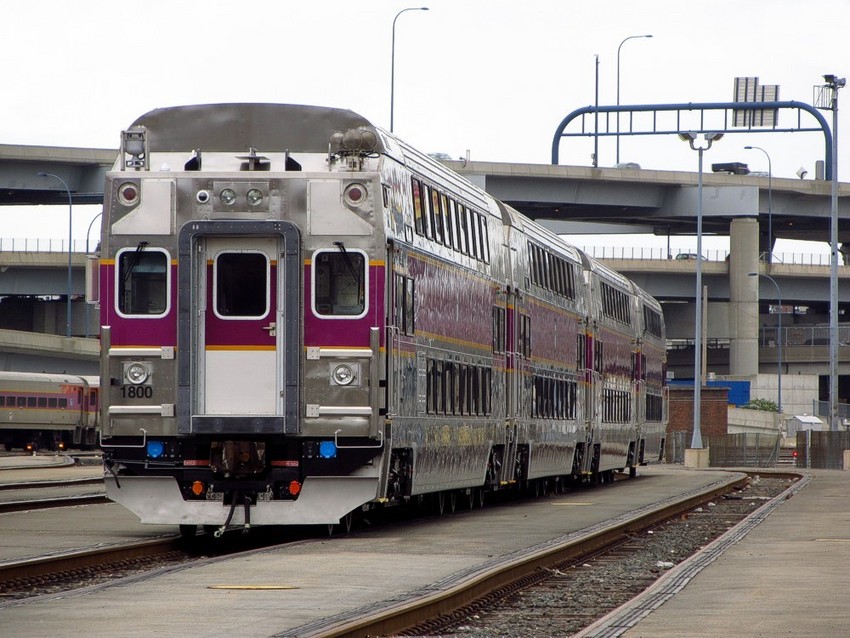
First New MBTA Double Decker Coaches Delivered to BET

The first four brand new Hyundai-Rotem double-deck coaches have arrived at Boston Engine Terminal.  The photo below was taken by David Hutchinson while off duty at BET. 

Photo by David Hutchinson